01
Infection
Sporozoite invasion of the liver.

Science
A conserved oligosaccharide, chemically synthesised, conjugated to a clinically and commercially validated carrier protein. The target is conserved across complex life-cycle stages, species, and even pathogens from different biological kingdoms — which is why the GPI SSCV platform extends beyond malaria to a pipeline of products with blockbuster potential.
The efficacy of protein-targeting vaccines is limited by variation — the protein target on the pathogen changes or disappears altogether. Instead of a protein, our GPI target is an oligosaccharide that is less easily varied and more highly conserved across parasites, mycobacteria and fungal pathogens. They have evolved over millennia to exploit GPI as the lynchpin of their strategy to evade our immune systems, but in doing so have exposed their own Achilles’ heel. We target GPI to defeat them.
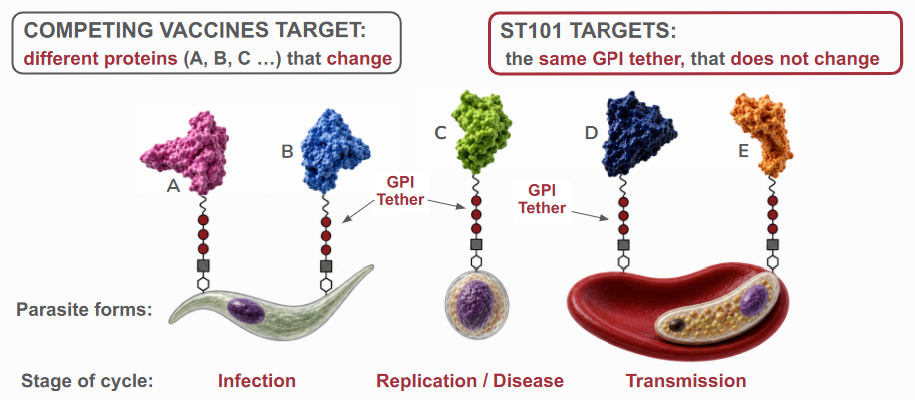
Preclinical studies of ST101 show high-titre anti-GPI antibodies, prevention of sporozoite infection, limited blood-stage replication, neutralisation of the dominant GPI toxin, and blockade of sexual-stage transmission — with potent synergy against GPI-anchored protein vaccines, including homologues of RTS,S and R21. Compounding efficacy in all species — across all stages.
01
Sporozoite invasion of the liver.
02
Parasite expansion inside hepatocytes.
03
Blood-stage replication and GPI toxin.
04
Sexual stages taken up by the mosquito.
The saccharide is made by chemical synthesis, not bulk fermentation. Molecular definition, batch consistency, and a path to industrial scale without the need to grow huge cultures of pathogens.
The GPI glycan is linked to a clinically and commercially proven carrier-protein platform — the same as used for a $25B category of licensed bacterial glycoconjugate vaccines.
Our published clinical cohort data shows that natural immunity against our GPI target strongly correlates with less infection and less disease.
Stability under standard refrigeration, dosing compatible with WHO Expanded Programme on Immunization schedules, and a cost of goods designed for endemic-market access.
Across kingdoms
Mycobacterial phosphatidyl-myo-inositol mannosides share structural kinship with GPI. ST208, a synthetic PIM mannose conjugate, potentiated BCG more than ten-fold in murine tuberculosis — the first saccharide-conjugate vaccine with published in-vivo TB efficacy. Invasive fungi present a further kingdom leap now in discovery as ST300.
See the pipeline
Louis Schofield — publication record — indexed publications (EBSCO).